

Gene Roddenberry’s Planet Earth: A Dumbed-Down Retread That Lost What Made Genesis II Work


Gene Roddenberry tried again in 1974 with Planet Earth, his second attempt to launch a post-apocalyptic science fiction series after Genesis II failed to get picked up the previous year. The 80-minute pilot recycles the same premise. Dylan Hunt, a 20th-century scientist awakened in the 22nd century, works with PAX to rebuild civilization. This iteration replaces the cast, removes the setup, and trades Genesis II’s thoughtful worldbuilding for action-heavy formula that feels like watered-down Star Trek.
The result is more accessible but less intelligent, more action-packed but less original. Planet Earth works as pulp adventure, but it’s a step down from Genesis II in almost every way that matters.
What Changed and Why
ABC aired Genesis II in March 1973 to decent ratings with approximately 42% of the viewing audience, but chose to produce Planet of the Apes instead of picking up Roddenberry’s series. The network felt Genesis II was too cerebral, too slow, and too expensive for weekly production. Roddenberry retooled the concept, pitching it to other networks with changes designed to address those concerns.
Planet Earth was the result. Warner Bros. and ABC commissioned the new pilot with a different cast, a faster pace, and more emphasis on action. John Saxon replaced Alex Cord as Dylan Hunt. The supporting cast was entirely new, with no continuity from Genesis II. The pilot skips Hunt’s origin story entirely. This time, he’s already awake, already integrated into PAX, and already on missions. The film opens with Hunt and his team returning from an assignment, establishing the episodic structure the series would follow.
The change makes Planet Earth feel more like Star Trek. PAX operates from an underground complex that functions like a starbase. Teams travel via subterranean shuttles to different post-apocalyptic societies, encounter problems, solve them, and return home. It’s the Star Trek formula transplanted to Earth, and while that’s not inherently bad, it removes the fish-out-of-water dynamic that made Genesis II interesting. Hunt is no longer discovering this new world, but he’s already comfortable in it, which reduces dramatic tension.
The network wanted something more commercial, more action-oriented, and easier to produce on a weekly budget. Roddenberry delivered that, but at the cost of what made Genesis II distinctive.
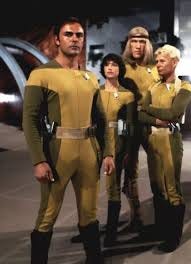
The Plot: Breeding Stock and Matriarchal Amazons
Planet Earth’s main storyline involves a PAX scientist who’s been shot and needs emergency heart surgery. No one at the PAX compound can perform the operation, so Hunt leads a team to find a surgeon. They travel to a region controlled by the Confederacy of Ruth, a matriarchal society where women rule and men are enslaved.
The Confederacy drugs men into docility, using them as laborers or “breeding stock” for reproduction. Hunt is captured and purchased by Marg (Diana Muldaur, who later played Dr. Pulaski in Star Trek: The Next Generation), a high-ranking woman in the Confederacy. She intends to use him for breeding, leading to a series of uncomfortable scenes where Hunt is objectified and treated as property.
This is where Roddenberry’s sexual preoccupations become unavoidable. The breeding stock concept is creepy, and the film lingers on it longer than necessary. Hunt seduces Marg in classic Captain Kirk fashion—using charm and physical attraction to manipulate a woman in power—and convinces her that gender equality is better than female domination. By the end, Marg agrees that men and women should be equals, the Confederacy’s leadership is overthrown, and everyone learns a lesson about cooperation.
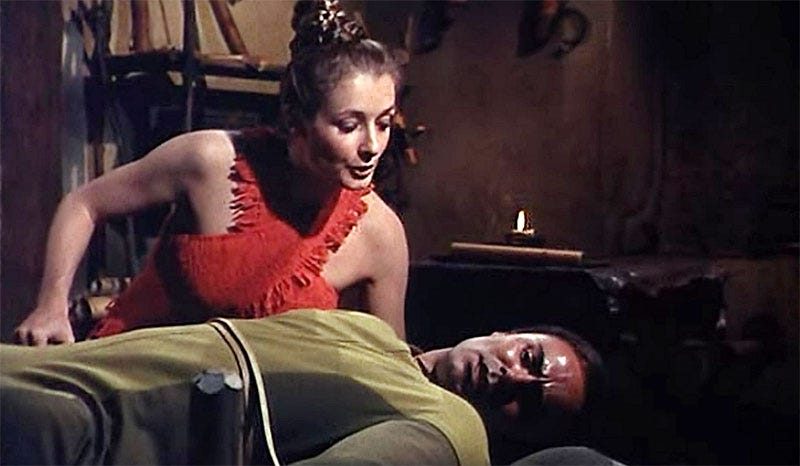
It’s silly. The message of ”women shouldn’t be in charge, men shouldn’t be in charge, we should have equality” is delivered with all the subtlety of a sledgehammer. The resolution feels unearned because the film doesn’t explore the Confederacy’s society in any depth. We’re told women rule because men destroyed the world with war, but we don’t see how that society functions or why it’s unsustainable beyond “domination is bad.” The ending is a tidy moral wrapped around a premise that was exploitative from the start.
Roddenberry had a pattern of creating scenarios where women in power are either seduced or proven wrong by male protagonists. Planet Earth is one of the more blatant examples. The Confederacy of Ruth exists to be a sexual fantasy, and then to be “fixed” by Hunt’s intervention. It’s the kind of weird sexual degeneracy Roddenberry promoted throughout his career, from Star Trek’s endless Kirk seductions to the various matriarchal societies that appeared in The Original Series.
What Works: Pacing and Action
Planet Earth uses its 80-minute runtime effectively. The pacing is brisk, the action sequences are competent, and the film never drags. Unlike Genesis II, which spent significant time on worldbuilding and character development, Planet Earth moves quickly from setup to conflict to resolution. That makes it more watchable as a standalone pilot, even if it’s less thoughtful.
The action is more prominent than in Genesis II. There are chases, fights, and a climactic confrontation where Hunt and his team rescue the captured scientist and escape the Confederacy. The film feels more like an adventure serial than a science fiction drama, which is what the network wanted. It’s entertaining in a pulp way, even if it’s not particularly smart.
John Saxon is a competent Dylan Hunt. He doesn’t have Alex Cord’s intensity, but he brings a more straightforward heroism to the role. Saxon’s Hunt is confident, capable, and charming, basically a Kirk clone without the starship. He’s less interesting as a character than Cord’s version, but he’s easier to root for in a conventional action-hero way.
The production values are solid for a 1974 TV movie. The PAX complex looks functional, the shuttles are believable, and the Confederacy’s sets convey a post-apocalyptic society that’s rebuilt with limited resources. The film doesn’t have the budget for elaborate effects, but it uses what it has efficiently.
What Doesn’t Work: Dumbed Down and Derivative
Planet Earth is less intelligent than Genesis II. The first pilot explored themes of identity, loyalty, and the cost of rebuilding civilization. It asked questions about whether humanity could overcome its worst impulses. Planet Earth asks whether women should be in charge and answers “no, but men shouldn’t either, so let’s compromise.” It’s a shallow message delivered through a shallow story.
The matriarchal society premise has been done to death in science fiction. Star Trek did it multiple times with ”Spock’s Brain,” “The Cloud Minders,” “Angel One.” The idea that a society ruled by women would enslave men is a lazy inversion of historical gender dynamics, and it doesn’t offer any insight beyond “domination is bad regardless of who’s doing it.” Planet Earth doesn’t explore why the Confederacy developed this way or what alternatives might exist. It just presents the society as a problem for Hunt to solve.
The breeding stock subplot is uncomfortable. Roddenberry clearly thought this was provocative and edgy, but it comes across as creepy wish fulfillment. Hunt is objectified, but the film treats it as titillating rather than disturbing. When he seduces Marg, it’s framed as him taking control of the situation rather than as a survival tactic in a coercive environment. The power dynamics are messy, and the film doesn’t acknowledge that.
The supporting cast is forgettable. Genesis II had memorable characters like Lyra-a, whose internal conflict between loyalty to the Tyrannians and growing respect for Hunt drove much of the drama. Planet Earth’s supporting characters are functional but bland. They exist to move the plot forward, not to be interesting in their own right.
The ending is too neat. The Confederacy’s leadership is overthrown, gender equality is established, and everyone moves on. There’s no sense of how this society will actually function going forward or what challenges it will face. The resolution exists to wrap up the pilot, not to explore the consequences of the story’s events.
The Historical Context: Roddenberry’s Struggle in the 1970s
Planet Earth was Roddenberry’s second attempt to launch a new science fiction series after Star Trek’s cancellation in 1969. Genesis II failed to get picked up despite decent ratings. Planet Earth was commissioned as a potential series, and ABC was close to greenlighting it. The network ordered the pilot, tested it with audiences, and considered it for the 1974-75 season.
But Planet Earth didn’t get picked up either. ABC passed, and Roddenberry tried one more time with Strange New World in 1975, a third pilot using the same premise but without Roddenberry’s direct involvement which we won’t bother to cover on Fandom Pulse because it’s not worth the time. That failed too, and the Dylan Hunt concept died.
Roddenberry spent the 1970s trying to recapture Star Trek’s success and failing repeatedly. Genesis II, Planet Earth, Strange New World, The Questor Tapes, and Spectre, all were pilots that didn’t become series. It wasn’t until Star Trek: The Motion Picture in 1979 that Roddenberry returned to prominence, and even that was a troubled production.
The networks wanted something more commercial than Genesis II but less cerebral than Star Trek. Planet Earth was Roddenberry’s attempt to thread that needle, and it didn’t work. The film is too formulaic to stand out and too shallow to justify its premise. It’s competent television that doesn’t offer anything audiences couldn’t get elsewhere.
Final Verdict
Planet Earth is a six out of ten. It’s watchable, action-packed, and competently made, but dumbed down and derivative compared to Genesis II. The pacing is good, the action is solid, and John Saxon is a capable lead. But the story is shallow, the matriarchal society premise is exploitative, and the resolution is too neat to be satisfying.
Genesis II was the better pilot. It had more original ideas, more thoughtful worldbuilding, and more interesting characters. Planet Earth traded those strengths for accessibility and action, and the result is a less memorable film. It’s probably for the best that this didn’t become a series—Roddenberry’s sexual preoccupations and formulaic storytelling would have worn thin quickly.
If you’re a Roddenberry completist or a fan of 1970s science fiction pilots, Planet Earth is worth watching once. But it’s not essential, and it’s not as good as Genesis II. Roddenberry was still searching for his next hit, and this wasn’t it.
Rating: 6/10
Competent action and solid pacing can’t overcome a shallow premise, uncomfortable sexual dynamics, and a dumbed-down approach that removes what made Genesis II interesting. Worth a watch for historical curiosity, but not much more.
What do you think? Should Planet Earth have been picked up as a series, or did ABC make the right call passing on it?
For a great alternative to mainstream science fiction with spy thriller action, read The Stars Entwined on Amazon and support Fandom Pulse!

NEXT: Gene Roddenberry’s Genesis II: The Post-Apocalyptic Pilot That Almost Made It
If anything these pilots that spawned no offspring, no children can be taken as proof that whatever good qualities Star Trek had, they were owed to people other than creepy old Roddy, like for example as some suggest, the other Gene, if not many many more people, from writers to actors and more.
Not to say the man was devoid of ability (might be jumping the gun to say that), but clearly he was at least in that category of person who needs a roomful of people with the authority to say no to terrible ideas.
It's definitely difficult to produce sex on the mainstream screen, given content restrictions, guidelines & audience expectations.
Just look at Farscape! That show tried desperately to be an antithesis of TNG. What we got was cringeworthy and laughable.