



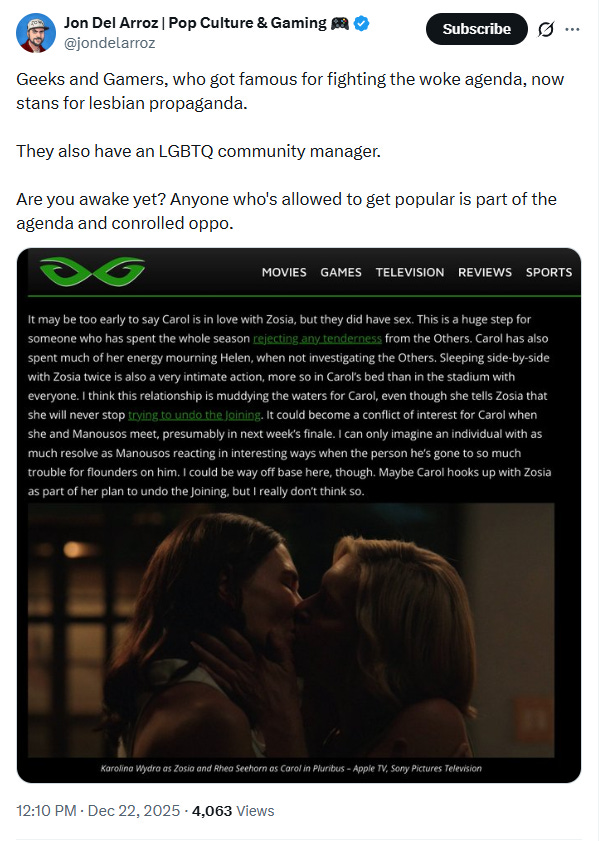
I was inspired to write about this in response to Jon Del Arroz's post concerning Jeremy Griggs:
The Gatekeeping Instinct
What inspired my thinking about this subject was based on my listening to Vox Day and Jon Del Arroz discuss my article about EndymionTV in a Live Stream on YouTube. There, remember Vox Day distinctly referring to Endymion's behavior as "gatekeeping."
While many online fan groups often present themselves as welcoming hubs built around shared enthusiasm, beneath the surface lies a very different impulse: gatekeeping. And, no, this is not the kind of gatekeeping aimed at protecting a franchise from corporate meddling or misguided creative decisions (and those are far beyond the reach of ordinary fans anyway) but the kind directed at the only people these communities can actually influence: other fans.
The irony here is striking: spaces ostensibly created to celebrate a shared love of a story, game, or universe frequently become battlegrounds where long‑time members police who is “worthy” of participating.
This dynamic is especially visible on platforms like Reddit. While Reddit’s voting system is often criticized for being structurally flawed (rewarding conformity, punishing nuance, and burying dissent) it is only part of the problem. The deeper issue lies in the moderation culture that has evolved there. Many subreddits are governed by small groups of moderators who wield outsized authority, often without the temperament, expertise, or impartiality that such roles demand. Their decisions can feel arbitrary, ideological, or simply self‑serving. And because moderation is one of the few forms of power available in these digital spaces, some cling to it with a kind of zeal.
The result is a feedback loop where moderators enforce their preferences, users learn which opinions are “acceptable,” and the community narrows into an echo chamber. Disagreement becomes deviance and critique becomes heresy. Even mild variation from the dominant viewpoint can be met with hostility, downvotes, or outright removal. What should be a space for diverse interpretations and lively debate instead becomes a gatekeeping machine where the goal is not to enrich the fandom but to control it.
At its core, this behavior stems from a very simple human impulse: people want ownership over the things they love. But since fans can’t control the direction of the franchise itself, they try to control the narrative around it.
Who Is Geeks + Gamers?
Jeremy Griggs is the founder and public face of Geeks + Gamers, a prominent figure in the world of YouTube pop‑culture commentary. His rise to widespread visibility, however, came largely from his outspoken commentary on modern entertainment, particularly Star Wars, and the backlash to The Last Jedi became a defining moment for his channel.
As many Reddit discussions note, Jeremy became known for his anti‑SJW framing and his extensive criticism of Disney’s handling of the Star Wars franchise. His videos dissecting the film’s writing, character choices, and perceived political messaging resonated with a large segment of disillusioned fans. This period marked the transformation of Geeks + Gamers from a gaming‑focused community into a broader cultural commentary platform.
A major component of Jeremy’s online identity was his commentary on Hollywood figures, and none has been more central to his content than Brie Larson. The actress became a recurring subject on the Geeks + Gamers channel, especially around the release of Captain Marvel.
The vehemence of his critiques of Star Wars: The Last Jedi are an interesting detail given a video on his channel he uploaded in January, 2018, entitled "The Last Jedi - It's Time To Admit The Truth". There, he admits that, upon his initial viewing of Star Wars: The Last Jedi, he loved the film, granted that he says his initial reaction to the film shifted dramatically over multiple viewings. He says that after his first screening, he left the theater exhilarated, convinced he had witnessed something extraordinary. A second viewing introduced doubts, and by the third, he concluded that while the movie was visually stunning and entertaining on a surface level, it ultimately failed as a meaningful continuation of the Star Wars saga.
Now, the point of this essay is not to frame Jeremy's admission as some smoking gun proof he is a lying scumbag grifter. Instead, my point here is simply to use this as a case study for why many online fan communities serve absolutely no purpose other than to gatekeep other fan groups.
Why Fan Groups Are Ultimately Pointless
Let us address what happened between Jeremy and Zack Snyder back in March, 2021. There was a high‑profile charity livestream held to support suicide‑prevention efforts, an event hosted by Uche Nwaneri, a contributor to the Geeks + Gamers network. The event prominently featured the group’s branding. Film Director Zack Snyder joined the stream to promote the release of Zack Snyder’s Justice League, but he opened with a statement distancing himself from Geeks + Gamers, noting that while their logo appeared on the donation page, he and his film were not affiliated with the organization. Snyder said this regardless of whatever support Geeks + Gamers had displayed for him and his movie.
Snyder’s remarks were interpreted by many as a public rebuke of the group’s reputation, with outlets describing Geeks + Gamers as an “alt‑right” or anti‑SJW brand. The incident quickly escalated into a broader online controversy, with some fans praising Snyder for distancing himself and others criticizing him for blindsiding a group that had helped raise money for charity. In response, Jeremy and the Geeks + Gamers team released a video titled "The Truth – Zack Snyder Livestream Controversy Fully EXPLAINED," in which they expressed disappointment, clarified their intentions, and argued that Snyder’s comments unfairly fed into negative media narratives about their community.
The ordeal became a defining moment in the public perception of both Snyder and Geeks + Gamers. For Snyder, it was seen as a firm rejection of the fandom; for Jeremy, it became a symbol of what he and his supporters viewed as Hollywood’s willingness to distance themselves from fan communities.
The Snyder incident serves to highlight the increasingly adversarial relationship between creators and consumers. For many long‑time fans, this tension isn’t rooted in a single event but in a broader pattern in which modern franchises seem to disregard the desires of their most dedicated audiences.
When Conflict Becomes Marketing
Lest one think an adversarial relationship would lead to the death of one or the other party, think again. Instead, the corporations have parasitized fandoms which is yet another reason why fan groups are pointless.
Consider the controversy surrounding actress Moses Ingram during the release of the Obi‑Wan Kenobi show. It became a revealing case study in how modern entertainment companies propagate and leverage conflict within their own fanbases. When Ewan McGregor publicly condemned segments of the Star Wars fandom as racist in response to the alleged harassment actress Moses Ingram reported receiving online, the moment was astroturfed, becoming bigger than the show itself.
This goes to show that even negative attention is a viable form of market visibility. The Moses Ingram situation illustrated how quickly a studio can pivot from promoting a story to promoting a stance and framing the narrative around their moral alignment rather than the narrative quality of the product they were selling. And what's funny is the influencers who covered the drama were essentially being propped up as free advertisements for the Obi-Wan Kenobi show.
Why Fans Will Never Be In Control
As franchises expand into global cultural institutions, they stop functioning merely as entertainment and begin operating as branding platforms meant to shape public discourse. At that scale, storytelling becomes inseparable from influence. And influence, once acquired, is something corporations have no incentive to surrender.
This is yet another reason why fan groups are pointless. When a franchise reaches mass‑market ubiquity, its audience is no longer defined by long‑time fans but by the broadest possible demographic. This shift fundamentally changes the creative calculus. Instead of crafting narratives that honor established lore or satisfy niche desires, the narratives serve as ideological pulpits for progressive politics.
This leads to an uncomfortable question: do franchises ever change course in response to fan desires? The answer is yes, but such changes are often superficial. More often, franchises double down on their chosen direction, even when large segments of the fandom express dissatisfaction. From the perspective of frustrated fans, it can feel as though their collective voice is irrelevant unless it aligns with the creative or ideological priorities of the studio.
Conclusion
Geeks and Gamers, who got famous for fighting the woke agenda, now stans for lesbian propaganda?
It makes perfect sense.
Jon’s claim that Jeremy functions as “controlled opposition” lands in an unexpected way. It is not because there is some shadowy organization pulling his strings but because Jeremy’s entire persona has always been shaped by the people who watch him. He isn’t controlled by institutions so much as he is controlled by the expectations, moods, and biases of his own audience. This kind of self love is symptomatic of a spiritual faggotry that inevitably culminates in literal homosexuality.
So, of course, Geeks + Gamers would have an LGBTQ community manager.
This affirmation bias is common across successful YouTube channels and fandom‑driven franchises. Influencers often present themselves as independent thinkers or renegade truth‑tellers, yet their survival depends on constant affirmation from their followers. Over time, this creates what could be called “literally me” behavior: the influencer becomes a projection surface for the audience’s grievances, preferences, and identity. The creator stops leading and starts echoing. The audience stops engaging critically and starts demanding self‑validation. Both sides become trapped in a loop of mutual reinforcement.
The irony is that this dynamic mirrors the very corporate behavior these communities often criticize. They accuse studios like Disney of pandering, inserting personal politics, or crafting characters as wish‑fulfillment avatars, yet influencers do the same thing. They build brands around outrage, identity, and self‑insertion, then accuse others of narcissism while embodying it themselves. It’s the Spider‑Man pointing at Spider‑Man meme brought to life.
Jeremy’s shifting stance on The Last Jedi is a perfect example. His position didn’t evolve because of new insight or principle; it changed because the winds of his audience shifted.
The algorithm rewards volatility, not integrity.
If you apply the same logic to Jeremy’s treatment of Brie Larson, the pattern becomes even clearer. His hostility toward her wasn’t born from some deeply held principle or a coherent philosophy about filmmaking. It was a performance calibrated to match the emotional temperature of his audience.
When Captain Marvel became a flashpoint in online culture wars, the outrage economy kicked into overdrive. Brie Larson became a symbol onto which people projected anxieties about representation, feminism, and changing cultural norms. Influencers who built their brands on “anti‑woke” sentiment quickly realized that attacking her was algorithmic gold.
Jeremy didn’t lead that charge; he followed it. The intensity of his criticism rose in direct proportion to how much engagement those videos generated. The harsher he was, the more the audience rewarded him. This is the same “literally me” dynamic: the influencer becomes a vessel for the audience’s grievances, and the audience becomes addicted to seeing its own frustrations reflected back at them.
Yet, in the end, Jeremy’s fanbase hasn’t reshaped the entertainment landscape nor forced any meaningful course correction. For all the noise, outrage cycles, and self‑congratulation, the franchises they targeted haven’t bent to their will. Instead, they’ve doubled down. Studios continue telling the stories they want to tell, and the cultural shifts these audiences rail against have only accelerated. The only real transformation has been within the outrage ecosystem itself, where creators like Jeremy adapt to whatever keeps their audience engaged. The industry moves on, but the feedback loop remains, convincing its participants that they’re winning even as nothing changes outside their own echo chamber.
NEXT: Jimmy Kimmel To Give Lecture About Fascism In Christmas Message
 | A guest post by
|
I stopped watching G&G a couple years ago, when I realized most of their content had become recycled commentary on someone else's writing or video. To be fair, it had mostly been that the whole time; Jeremy and his wife had their own content to promote and the conservative clickbait that generated from the "reread someone's article and snarkily comment on it" videos served as a relatively easy way to advertise their own material. By the time I quit watching, most all of their content had become CONTENT, rehashed from somewhere else and containing no new insight worth engaging.
But they were never conservative or traditional. If we're being honest, they never hid their middle-of-the-road attitude toward homosexuality. Jeremy and his wife were never interested in morality arguments; they're Gen Xers who were shocked by the overreach from the liberal left that folks like them had supported from the 90s through the 2010s. Shock doesn't last forever, though, so it's no surprise at all that people like them, who care more about vague concepts of freedom than pursuing and establishing what is good and right, will eventually return to tolerating a wide Overton Window. That's the path of least intellectual resistance; it conveniently stops you from having to answer the questions you ask. It allows you to adopt platitudes like "the journey matters more than the destination, bro", and relieves you of the responsibility of making hard decisions.
In the Bible, Jesus uses the parable of seeds falling on different types of ground, to describe the four different types of people who receive faith; the same analogy works for any kind of truth. People like G&G are the rocky ground, where the seed takes quickly but the soil is too shallow so nothing grows for long. In their case the rocks represent perceived persecution from "unfairness", the difficulty that comes from having to actually understand specific intellectual ethical arguments, and the emotional discomfort of telling people unhappy truths; these things kill off the initial impetus toward moral principle.
The Jeremys of the world grew the anti-woke movement but they will never power it; they will always be unreliable allies, predictable only in the fact that they will eventually stop caring about the thing that first tempted them to look at something greater than going along to get along. More the fools are we if we continue to ignore that reality.
Yes